WHAT IS THE MODERN AGE IN ENGLISH LITERATURE
Introduction to the Modern Age
When students ask, “What is Modern Age in English Literature?”, they are really asking about one of the most complex, experimental, and revolutionary periods in literary history. The Modern Age marks a sharp break from traditional ways of writing and thinking. It represents a time when writers stopped trusting old beliefs and began questioning everything—God, society, morality, love, and even language itself.
The Modern Age in English Literature roughly begins around 1900 and continues until 1945, ending with the Second World War. This period was shaped by rapid industrial growth, scientific discoveries, urbanization, psychological theories, and global wars. Life no longer felt stable or meaningful, and literature reflected this confusion.
Unlike Romantic or Victorian writers, modern writers were not interested in beauty, optimism, or moral
lessons. Instead, they focused on the inner life of individuals, showing anxiety, loneliness, frustration, and emotional conflict. Literature became darker, deeper, and more intellectual.
In simple words, the Modern Age is the literary voice of a world that felt lost, broken, and uncertain, yet desperately searching for meaning.
Historical Background of the Modern Age
To fully understand what the Modern Age in English Literature is, we must look at the historical background that shaped it. Literature is never created in isolation—it grows directly from social and historical realities.
Impact of World Wars
The First World War and the Second World War were the biggest shocks to human civilization. Millions were killed, empires collapsed, and faith in progress was completely shattered. Writers who once believed in human goodness now witnessed destruction on a massive scale. War caused:
- Psychological trauma
- Loss of faith in governments and religion
- Fear, anxiety, and emotional numbness
This experience created disillusionment, a key feature of modern literature. Writers like T.S. Eliot expressed cultural decay, while novelists showed characters suffering silently from emotional wounds.
Industrialization and Urban Life
Industrialization changed human life forever. People moved from villages to cities, living in crowded, mechanical environments. While cities promised progress, they also created:
- Isolation
- Loneliness
- Loss of human connection
Modern writers often describe the city as cold, confusing, and dehumanizing. Urban life became a symbol of modern emptiness.
Psychological and Social Changes
Theories of Sigmund Freud transformed how people understood the human mind. Writers became interested in:
- Dreams
- Subconscious desires
- Hidden fears
Society was no longer stable. Traditional family structures, religious beliefs, and moral values were
breaking down, leading to identity crises in modern characters.

What Is Modernism in English Literature
While discussing the Modern Age in English Literature, we must clearly understand Modernism, the major literary movement of this period.
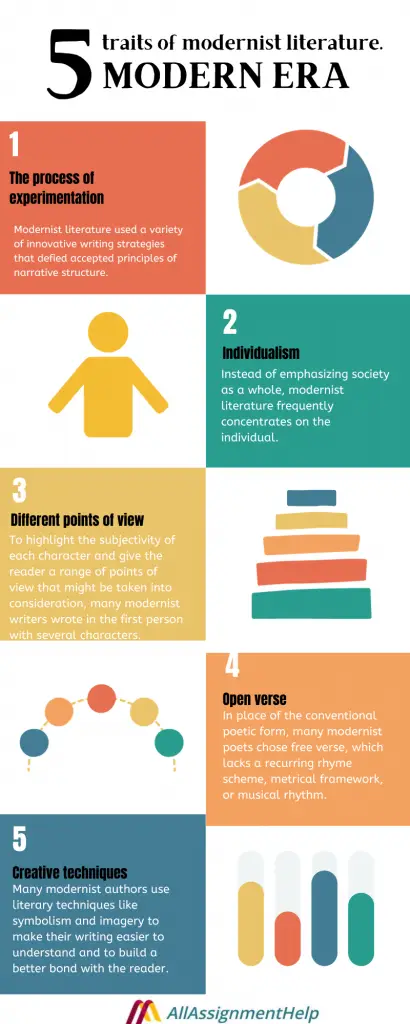
Modernism was not just a style—it was a reaction against tradition. Writers rejected Victorian realism and predictable plots. They believed traditional forms could no longer express modern reality.
Difference Between Modern Age and Modernism
Aspect | Modern Age | Modernism |
Nature | Time period | Literary movement |
Scope | Historical + cultural | Artistic + literary |
Focus | Social change | Experimental writing |
Modernism focused on new forms, new techniques, and new perspectives. Writers like James Joyce and Virginia Woolf completely reshaped narrative style.
Key Features and Characteristics of the Modern Age in English Literature
The Modern Age in English Literature has distinct characteristics that clearly separate it from earlier literary periods.
Break from Tradition
Modern writers deliberately broke traditional rules. They rejected:
- Fixed plot structures
- Moral endings
- Formal language
They believed life was chaotic, so literature should reflect that chaos.
Individualism
Modern literature focuses on the individual mind, not society as a whole. Characters are often:
- Lonely
- Confused
- Emotionally unstable
The inner world matters more than outer events.
Pessimism and Disillusionment
Optimism disappears in modern literature. Writers portray:
- Hopelessness
- Fear
- Loss of belief in religion and institutions
The modern world feels broken and meaningless.
Fragmentation
Modern texts are often fragmented—stories jump between thoughts, memories, and time periods. This
reflects how modern people experience reality.
Psychological Depth
Modern writers explore the mind deeply. Thoughts, emotions, memories, and fears take center stage.

Major Themes of The Modern Age in English Literature
Themes form the heart of literature. The Modern Age introduced bold and uncomfortable themes that reflected real human struggles.
Alienation and Isolation
Modern individuals feel disconnected—from society, family, and themselves. Characters struggle to form meaningful relationships.
Loss of Faith
Religion no longer provides comfort. Writers question God, morality, and spiritual truth.
Meaninglessness of Life
Many modern works suggest life has no clear purpose. This theme is closely linked to existential philosophy.
Time and Memory
Time is not linear. Past memories constantly interfere with the present, shaping identity.
Inner Conflict
External action is minimal; internal struggle is intense. Characters battle their own minds.
Literary Techniques Used in the Modern Age
To express complex ideas, modern writers developed innovative techniques.
Stream of Consciousness
This technique presents thoughts as they naturally occur—random, emotional, and unorganized.
Used by:
- Virginia Woolf
- James Joyce
Interior Monologue
The character’s inner thoughts are directly presented without explanation.
Non-Linear Narrative
Events do not follow chronological order. Time moves freely.
Symbolism and Imagery
Objects and images carry deeper meanings, often representing emotional or spiritual states.
Modern Age Poetry
Modern poetry reflects intellectual depth and emotional complexity.
Characteristics of Modern Poetry
- Free verse
- Complex imagery
- Intellectual tone
- Cultural pessimism
Major Poets
- T.S. Eliot
– cultural decay - W.B. Yeats
– symbolism and mysticism - Ezra Pound
– modern poetic experimentation
Themes in Modern Poetry
- Spiritual emptiness
- Fragmented identity
- Search for meaning
Modern Age Drama
Modern drama moved away from melodrama and romance.
Features of Modern Drama
- Realistic dialogue
- Psychological realism
- Social criticism
Major Dramatists
- George Bernard Shaw
– social issues - T.S. Eliot
– poetic drama
Modern Age Novel
The modern novel focuses on
psychological realism rather than external action.
Key Developments
- Stream of consciousness
- Focus on inner life
- Experimental structure
Writers like James Joyce and Virginia Woolf transformed the novel into an artistic exploration of the human mind.
Major Writers of the Modern Age
Writer | Contribution |
T.S. Eliot | Modern poetry & symbolism |
Virginia Woolf | Stream of consciousness |
James Joyce | Experimental fiction |
D.H. Lawrence | Human relationships |
W.B. Yeats | Modern symbolism |
George Bernard Shaw | Social drama |
Comparison: Victorian Age vs Modern Age in English Literature
To truly understand the Modern Age in English Literature, it is very helpful to compare it with the
Victorian Age, which came just before it. This comparison clearly shows why the Modern Age feels darker, more complex, and more experimental.
Victorian Age vs Modern Age – Detailed Comparison Table
Aspect | Victorian | Modern |
Worldview | Optimistic, confident | Pessimistic, doubtful |
Faith | Strong belief in God and morality | Loss of faith and spiritual crisis |
Society | Stable social structure | Fragmented and unstable society |
Themes | Progress, morality, duty | Alienation, meaninglessness |
Characters | Clear moral identity | Confused, psychologically complex |
Writing Style | Traditional, structured | Experimental, fragmented |
Narrative | Linear and logical | Non-linear, subjective |
Purpose of Literature | Moral teaching | Psychological exploration |
Explanation in Simple Words
Victorian writers believed that literature should teach moral values and reflect social order. In contrast, modern writers believed the world had lost its order, so literature should express confusion, doubt, and emotional struggle.
The Modern Age does not offer solutions. Instead, it asks difficult questions and leaves readers
uncomfortable—but thoughtful.
Impact of the Modern Age on English Literature
The Modern Age completely transformed English literature. Its impact can still be seen in contemporary
writing, films, and even digital storytelling.
Major Literary Impacts
- Freedom of Expression
Writers were no longer bound by strict rules. They experimented freely
with language, form, and structure. - Psychological Realism
Literature moved from describing events to exploring the human mind. Inner
thoughts became more important than action. - New Literary Techniques
Techniques like stream of consciousness and interior monologue changed
storytelling forever. - Diverse Voices
Writers explored gender, sexuality, identity, and mental health—topics
previously ignored. - Foundation of Postmodern Literature
Without modernism, postmodern literature would not exist. The Modern Age
laid the groundwork for future experimentation.
Cultural Impact
The Modern Age taught readers that:
- Life is complex
- Truth is subjective
- Human experience cannot be simplified
This made literature more realistic, even when it felt confusing.
Why the Modern Age Is Important for Literature Students
For readers, understanding the Modern Age in English Literature is essential, not optional. This period forms the backbone of modern literary studies.
Academic Importance
- Most university syllabi include modern writers
- Helps in understanding modern literary theory
- Builds strong analytical and critical thinking skills
Conceptual Benefits
Students learn:
- How literature reflects history
- How psychology influences writing
- How form and content are connected
Exam-Oriented Value
Modern literature is frequently asked in:
- Short questions
- Long essays
- Critical analysis
Knowing features, themes, and writers makes exams much easier.
Common Misunderstandings About the Modern Age
Many students struggle with modern literature because of common misconceptions.
“Modern literature is meaningless. ”
Wrong.
It is meaningful, but meanings are hidden and symbolic.
“Modern writers don’t follow rules.”
True—but intentionally. They break rules to reflect reality.
“It’s too difficult to understand.”
Only at first. Once you understand themes and techniques, it becomes deeply relatable.
Visual Summary Table: Modern Age at a Glance
Element | Description |
Time Period | 1900–1945 |
Core Idea | Uncertainty and experimentation |
Dominant Mood | Pessimistic, reflective |
Focus | Inner psychological life |
Major Genres | Poetry, novel, drama |
Famous Writers | Eliot, Woolf, Joyce |
Key Technique | Stream of consciousness |
Conclusion
So, what is Modern Age in English Literature?
It is the literary expression of a world that lost its certainty but gained
self-awareness. The Modern Age shows us, humans as they truly are—confused,
anxious, lonely, and searching for meaning in a broken world.
Through bold themes, innovative techniques, and unforgettable writers, this age reshaped English literature forever. It teaches us that literature does not always comfort—it questions, challenges, and awakens us. Once you understand the Modern Age, you don’t just read literature—you experience the human mind itself.
Frequently Asked Questions (FAQs)
1. What is meant by Modern Age in English Literature?
The Modern Age refers to a literary period (1900–1945) marked by experimentation, psychological depth, and disillusionment.
2. What caused the rise of modernism?
World Wars, industrialization, urban life, and psychological theories led to modernism.
3. Who are the major writers of the Modern Age?
T.S. Eliot, Virginia Woolf, James Joyce, D.H. Lawrence, W.B. Yeats, and George Bernard Shaw.
4. What are the main themes of modern literature?
Alienation, loss of faith, meaninglessness, inner conflict, and time.
5. Why is modern literature difficult to understand?
It is because it uses symbolism, non-linear narratives, and psychological techniques.

“Welcome to EngLiteratureGuru. I am a dedicated and experienced University Lecturer, done my MS in English Literature with distinction, a literary scholar with a mission to simplify the world’s greatest English classics for students and enthusiasts. From the intricate verses of Modern Poetry to the dramatic depth of Shakespearean tragedies like Hamlet, I provide expert analysis, historical context, and exam-ready insights. My goal is to help you bridge the gap between reading a text and truly mastering its meaning.”