Introduction to Modernism in Literature
Modernism in literature stands
as one of the most transformative intellectual and artistic revolutions in
human history. Spanning roughly from the 1890s to the 1940s, it was not simply
a change in writing style — it was a complete reimagining of what literature
could do, say, and be. Modernist writers broke with centuries of established
convention, driven by a shared conviction that the old forms could no longer
contain the turbulence of modern experience.
Europe and North America
were convulsing under the weight of industrialisation, urbanisation, mass
warfare, and seismic shifts in science and philosophy. The God of traditional
religion was, as Friedrich Nietzsche declared in 1882, “dead”. Darwin had relocated humanity from the apex of divine
creation to the upper branch of an evolutionary tree. Freud had exposed the
unconscious as an ungovernable wilderness beneath the polished surface of
Victorian respectability. And Einstein had dissolved the very foundation of a
fixed, objective reality.
Literature, in this context,
faced a stark choice: continue painting prettified pictures of a world that no
longer existed, or invent new forms equal to the new chaos. The Modernists
chose the latter — with radical, lasting consequences.
“Make it new. — Ezra Pound, a rallying cry that became Modernism’s unofficial
motto”
At its core, Modernism was about breaking away from the past and redefining literature for a new era. Writers began questioning the values of previous centuries, challenging the idea of absolute truth, and experimenting with innovative literary techniques.
Instead of linear narratives, Modernist texts often presented fragmented perspectives. Instead of idealized characters, they explored flawed, complex, and deeply psychological individuals.
- Definition of Modernism in Literature
At its most fundamental, Modernism in literature refers to a broad cultural and artistic movement characterised by a deliberate break with the literary conventions of the nineteenth century. While scholars differ on precise dates, the movement is generally understood to span from approximately 1890 to 1945, with its peak of creative productivity and theoretical ferment concentrated between 1910 and 1930 — a period sometimes called “High Modernism.”
What Does “Modernism” Mean?
The word derives from the Latin modernus (“of the present time”), but in literary scholarship the term carries specific weight. Rather than simply meaning “contemporary,” Modernism describes a set of aesthetic principles, philosophical attitudes, and formal experiments that self-consciously positioned themselves against tradition. Key scholarly definitions include:
• Malcolm Bradbury and James McFarlane (1976): In their landmark critical anthology Modernism: A Guide to European Literature, Bradbury and McFarlane describe Modernism as “the art of the disoriented,” emerging from “a crisis of culture” that was simultaneously intellectual, spiritual, and aesthetic.
• Peter Childs (2000): In Modernism (Routledge Critical Idiom), Childs defines it as a movement concerned with individual consciousness, marked by formal experimentation and rejection of conventional narrative.
• Astradur Eysteinsson (1990): In The Concept of Modernism, Eysteinsson argues Modernism is best understood as “a critical theory of art” — less a style than a mode of questioning what art is and does.
These definitions share a common emphasis: Modernism is defined not by what it adds but by what it refuses — refused linearity, refused omniscience, refused moral certainty, refused the comforting illusion of stable reality.
Modernism vs. “Modernity”
An important distinction: “modernity” refers to the historical era of industrial capitalism, democracy, and scientific reason — roughly from the seventeenth century onward. “Modernism,” by contrast, is the aesthetic response to the anxieties that modernity generated. Not every writer of the modern era is a Modernist; what distinguishes Modernist writers is their self-conscious, critical, and experimental engagement with the experience of living in the modern world.
Unlike Romanticism, which celebrated nature, beauty, and the imagination, or Realism, which aimed to depict life “as it is,” Modernism acknowledged that reality itself is unstable, subjective, and fragmented. The literary critic Malcolm Bradbury famously described Modernism as “the art of the disoriented.”
Modernism was not just about style—it was about a philosophical outlook. It reflected the disillusionment of a world where old certainties—religion, morality, social hierarchies—were crumbling. Writers began asking difficult questions: What does it mean to be human in a mechanized world? Is there such a thing as truth? How do we define meaning in the absence of God or universal values?
Thus, Modernism was as much a worldview as it was a literary movement.
To fully understand Modernism in literature, we must look at the historical forces that shaped it.
The Late 19th and Early 20th Century Context
The seeds of Modernism were sown during the late 19th century, a time of tremendous upheaval. Cities expanded rapidly, technology transformed daily life, and social structures began to shift. The traditional agrarian lifestyle gave way to industrial societies, creating both opportunities and disorientation. Writers sought new ways to reflect these changes.
The Impact of Industrialization, Science, and Technology
The Industrial Revolution reshaped human experience in profound ways. Machines, railroads, electricity, and later automobiles and airplanes collapsed distances and redefined time. Alongside these advances came new philosophies and sciences. Darwin’s theory of evolution challenged biblical creation narratives, Freud’s psychoanalysis redefined the human psyche, and Einstein’s relativity shook the foundations of physics. Each discovery contributed to a sense that the old ways of thinking no longer applied.
World Wars and Their Influence
Perhaps nothing shaped Modernism more than World War I (1914–1918) and World War II (1939–1945). The brutality, destruction, and disillusionment left people questioning humanity itself. The war shattered illusions of progress and civilization, leading to feelings of alienation, despair, and cynicism. Writers like Wilfred Owen and T.S. Eliot expressed this disillusionment in works that rejected patriotic glorification and instead highlighted the emptiness of modern existence.
In short, Modernism arose because the world was no longer recognizable. The traditional narratives of religion, morality, and culture no longer provided stability, and literature had to reinvent itself to make sense of a fractured reality.
Historical Context and the Roots of Modernism
No literary movement emerges in a vacuum. Modernism was the direct offspring of a century of unprecedented intellectual, technological, and social disruption. To understand it fully, we must trace its roots across four major domains of change.
1. The Crisis of Faith and the Death of Certainty
The nineteenth century had already weakened the foundations of European religious and philosophical certainty before the Modernists arrived. Three intellectual earthquakes were particularly decisive:
• Charles Darwin’s On the Origin of Species (1859): Darwin’s theory of evolution by natural selection displaced humanity from its privileged position at the centre of creation. If humans were not divinely crafted but rather the product of blind biological forces, what became of moral order? Of purpose? Of meaning? These questions haunted Modernist literature from its earliest days.
• Friedrich Nietzsche’s declaration of the “death of God” (1882–1887): Nietzsche’s proclamation — most famously in The Gay Science and Thus Spoke Zarathustra — was not atheistic triumphalism but a tragic diagnosis. Without God, Nietzsche argued, humanity loses its moral compass and must create new values. The Modernists took this burden of value-creation as both terrifying and liberating.
• Sigmund Freud’s Interpretation of Dreams (1899): Freud’s mapping of the unconscious mind revealed that human beings were strangers to themselves — that beneath the rational surface lurked desires, traumas, and drives that governed behaviour invisibly. This discovery was dynamite for literature: if consciousness was not transparent, then the novel of authorial omniscience was a lie.
2. Industrialisation and the Transformation of Everyday Life
By the late nineteenth century, industrialisation had fundamentally altered the rhythms of human existence. Factory work replaced agricultural labour. Cities swelled with migrants. The pace of life accelerated. Traditional community bonds — rooted in village, church, and family — were severed by the anonymous crowds of the industrial metropolis.
Writers registered this transformation with alarm. The city — London, Paris, Dublin, New York — became the definitive setting of Modernist literature: labyrinthine, impersonal, overwhelming, and strangely beautiful. T.S. Eliot’s London in The Waste Land (1922) is a “Unreal City” populated by hollow commuters. Joyce’s Dublin in Ulysses (1922) is simultaneously intimate and alienating. Virginia Woolf’s London in Mrs. Dalloway (1925) is a theatre of surfaces and hidden depths.
3. The First World War: The Catastrophe That Made Modernism
If any single event can be said to have crystallised Modernism’s worldview, it is the First World War (1914–1918). The war destroyed, at an industrial scale, the nineteenth century’s faith in progress, civilisation, and rational governance. Approximately seventeen million people died. The mechanisms of destruction — poison gas, machine guns, barbed wire, aerial bombardment — made a mockery of chivalric notions of heroism.
Writers who survived the trenches returned unable to narrate their experience in traditional forms. Wilfred Owen’s poetry, composed in the trenches and published posthumously in 1920, used bitter irony to expose the lie of glorious sacrifice. His poem Dulce et Decorum Est ends by calling the Latin tag about dying sweetly for one’s country “the old Lie.” This disillusionment — the exposure of official narrative as fraudulent — became a defining attitude of Modernist writing across all genres.
“After such knowledge, what forgiveness? — T.S. Eliot, Gerontion (1920)”
Paul Fussell, in The Great War and Modern Memory (1975), argued that the First World War transformed the language of irony and disillusionment that characterises Modernist literature. He described the war as perhaps the last occasion when hierarchical status and command were not entirely absurd.
4. Scientific Revolution: Einstein, Relativity, and the Dissolution of Fixed Reality
Albert Einstein’s Special Theory of Relativity (1905) and General Theory (1915) demolished the Newtonian universe — a clockwork cosmos governed by absolute time and fixed space. For Einstein, time was not a universal constant but a variable dependent on the observer’s position and velocity.
The literary parallel was immediate. If reality was observer-dependent — if there was no single, authoritative vantage point from which the truth of experience could be objectively narrated — then the omniscient Victorian narrator was not just unfashionable: it was philosophically indefensible. The Modernists responded by multiplying perspectives, fragmenting chronology, and foregrounding the subjectivity of all perception.
- Key Characteristics of Modernism in Literature
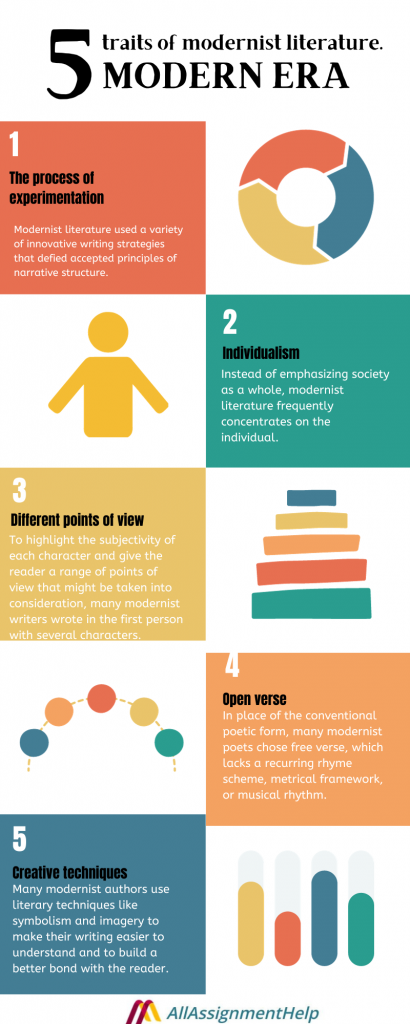
Modernism can be identified through several recurring features. These characteristics appear across genres—poetry, prose, and drama—making Modernist literature strikingly distinct.
Experimentation with Form and Style
Modernist writers rejected conventional structures. Novels no longer needed to follow chronological order; poems abandoned rhyme and meter; plays defied theatrical norms. Writers experimented with narrative techniques such as fragmentation, symbolism, and disjointed timelines.
Subjectivity and Stream of Consciousness
Stream of Consciousness
Perhaps the most celebrated
Modernist technique, stream of consciousness attempts to replicate the actual
flow of mental experience — thoughts, sensations, memories, and associations —
without the mediation of an ordering narrator.
Virginia Woolf described her
method in her essay Modern Fiction (1921) as an attempt to capture “the
myriad impressions” that “the mind receives — trivial, fantastic,
evanescent, or engraved with the sharpness of steel.” In Mrs. Dalloway,
this produces passages like the following, as Clarissa Dalloway walks through
London:
“What
a lark! What a plunge! For so it had always seemed to her when, with a little
squeak of the hinges, which she could hear now, she had burst open the French
windows and plunged at Broadstairs into the open air. — Virginia Woolf, Mrs.
Dalloway (1925)”
James Joyce pushed the technique
further in the final chapter of Ulysses — Molly Bloom’s soliloquy — which runs
to approximately forty pages with almost no punctuation, mimicking the
unpunctuated flow of thought at the edge of sleep.
Modernist authors often explored the subjective nature of reality. Instead of focusing on external events, they delved into the minds of characters. The “stream of consciousness” technique—used by James Joyce and Virginia Woolf—allowed readers to experience thoughts and emotions directly, mimicking the flow of the human mind.
Fragmentation and Dislocation
Modernist literature reflects a world in pieces. Narratives are often fragmented, characters isolated, and meanings ambiguous. This mirrors the uncertainty and instability of modern existence.
Modernist texts deliberately
disrupt the linear, cause-and-effect structure of Victorian narrative. Time
fractures; perspective shifts; plots dissolve into episodes, images, and
juxtapositions.
T.S. Eliot’s The Waste Land
(1922) is the supreme example. The poem consists of five sections, drawn from
dozens of sources — Dante, Shakespeare, the Bible, Sanskrit scripture,
contemporary London street life — assembled without explanatory transition.
Eliot’s own notes, appended to the poem’s first publication, acknowledged the
poem’s borrowings but did not smooth over its disjunctions. The effect is
deliberately disorienting — mirroring the fragmented consciousness of post-war
Europe.
“These
fragments I have shored against my ruins. — T.S. Eliot, The Waste Land (1922),
“What the Thunder Said”
Unreliable and Multiple Perspectives
Modernist fiction frequently
abandons the omniscient narrator in favour of limited, subjective, or even
unreliable points of view. William Faulkner’s The Sound and the Fury (1929)
tells the story of the Compson family through four distinct narrators —
beginning with Benjy, a cognitively disabled man whose perception of time is
non-sequential. The reader is denied any single authoritative account.
This formal choice is
philosophically significant: it enacts the Modernist conviction that there is
no God’s-eye view of reality, only the partial, contingent perspectives of
individual consciousness.
4. Intertextuality and Allusion
Modernist writers saturated
their work with allusions to prior texts — classical mythology, Renaissance
drama, Eastern philosophy, anthropology. This was not mere erudition; it was a
structural technique. By setting contemporary experience against ancient or
mythological frameworks, Modernists created what T.S. Eliot called — in his
essay Ulysses, Order and Myth (1923) — “a continuous parallel between
contemporaneity and antiquity,” which gave “a shape and a
significance to the immense panorama of futility and anarchy which is
contemporary history.”
Joyce’s Ulysses parallels
Homer’s Odyssey throughout: Leopold Bloom corresponds to Odysseus, Stephen
Dedalus to Telemachus, Molly Bloom to Penelope. This mythological scaffolding
gives a single Dublin day the resonance of an epic journey.
5. Experimentation with Time
Modernists were profoundly
interested in the difference between clock time and psychological time — what
the French philosopher Henri Bergson called “durée” (duration): the
sense that time flows differently in consciousness than it does on a watch
face.
In Woolf’s To the Lighthouse
(1927), the middle section — “Time Passes” — covers a decade in ten
pages of lyrical prose, while the novel’s outer sections cover only a day each.
Mrs. Ramsay’s death is mentioned parenthetically, in brackets, as if time swallowed
it whole. This structural asymmetry perfectly mirrors the way human memory
works: some moments last forever; entire years evaporate.
6. Focus on Interiority over External Action
While Victorian novels were
predominantly driven by plot — marriage, inheritance, social rise and fall —
Modernist novels privileged the inner life. External events matter less than
the consciousness that experiences them.
Woolf articulated this shift
directly in Modern Fiction: “The proper stuff of fiction does not exist;
everything is the proper stuff of fiction, every feeling, every thought; every
quality of brain and spirit is drawn upon.” The consequence was novels in
which “nothing happens” by conventional standards — yet in which the
texture of lived experience is rendered with extraordinary precision.
Rejection of Traditional Morality and Authority
Modernists were skeptical of religion, nationalism, and established authority. Instead, they questioned values, dismantled myths, and exposed hypocrisy. Their literature often portrays individuals adrift in a meaningless world.
Taken together, these characteristics reveal that Modernism was more than just a new style—it was a radical break from the past.
Major Themes of Modernist Literature
Themes in Modernist literature reflect the anxieties and challenges of the early 20th century.
Alienation and Isolation
One of the most persistent themes is the individual’s sense of alienation in a fragmented, impersonal world. Characters often feel disconnected from society, family, and even themselves. Kafka’s The Metamorphosis perfectly captures this theme, where Gregor Samsa’s transformation into an insect symbolizes existential alienation.
Breakdown of Social Order
Modernist works often show a collapse of traditional social structures. Hierarchies, norms, and values , once taken for granted, are shown unstable. For example, in T.S. Eliot’s The Waste Land, civilization appears decayed and spiritually barren.
Search for Meaning and Truth
In a world without certainty, Modernist characters frequently search for meaning. Yet this search often ends in ambiguity or despair, reflecting the crisis of faith in universal truths.
Time, Memory, and Consciousness
Modernist writers were fascinated by the subjectivity of time and memory. Works like Woolf’s Mrs. Dalloway show how time flows differently in the human mind compared to clock time, emphasizing the role of memory and perception in shaping experience.
The Impossibility of Communication
Modernist writers were acutely
aware that language — the very medium of literature — was inadequate to the
task of expressing inner experience. Words are public, shared, conventional;
but consciousness is private, fluid, and resistant to conventional form.
Samuel Beckett, working at the
extreme edge of Modernism’s dissolution into postmodernism, made the failure of
communication his central subject. In Waiting for Godot (1953), the characters’
circular, repetitive exchanges enact the impossibility of meaningful
communication. Beckett himself described his work as an attempt to express
“the mess” of experience without falsifying it through ordered form.
Mythic Structures as Scaffolding for Chaos
Faced with the absence of
religious certainty and the collapse of social order, several Modernist writers
turned to myth — not as belief but as structural method. Myth provided a
framework of recurring human experience against which the particulars of the
present could be measured.
T.S. Eliot drew on Jesse
Weston’s From Ritual to Romance (1920) and James Frazer’s The Golden Bough
(1890–1915) for the mythological substructure of The Waste Land. The Fisher
King legend — a wounded, impotent king presiding over a barren land awaiting
redemption — becomes Eliot’s metaphor for post-war Europe’s spiritual
exhaustion.
These themes not only defined Modernism but also made it one of the most intellectually and emotionally rich literary movements in history.
Theorists of Modernism
Modernism in literature did not emerge in isolation—it was heavily influenced by philosophical, psychological, and scientific thinkers who challenged old certainties and reshaped the intellectual landscape of the 19th and 20th centuries. These theorists provided the conceptual foundations for writers to explore new ideas, experiment with form, and push literature beyond traditional boundaries.
Sigmund Freud and Psychoanalysis
One of the most influential figures behind Modernist literature was Sigmund Freud, the father of psychoanalysis. Freud’s theories about the unconscious mind, repression, and the significance of dreams opened new ways of understanding human behavior. Writers like James Joyce and Virginia Woolf incorporated Freudian concepts into their stream-of-consciousness narratives, allowing readers to enter the intimate mental worlds of characters. Freud’s emphasis on sexuality, suppressed desires, and psychological conflict also encouraged writers to address topics previously considered taboo.
Friedrich Nietzsche and Nihilism
Another towering influence was Friedrich Nietzsche, the German philosopher who famously declared, “God is dead.” Nietzsche questioned morality, religion, and absolute truths, arguing that individuals must create their own values in a world without divine order. This philosophy profoundly influenced Modernist writers, who often depicted characters grappling with existential crises, alienation, and the burden of forging personal meaning in a chaotic world.
Karl Marx and Social Change
While Freud and Nietzsche dealt with psychology and philosophy, Karl Marx provided a political and social framework that influenced Modernist thought. Marx’s critique of capitalism and emphasis on class struggle shaped the way writers examined social inequality, alienation, and the oppressive structures of modern life. Literature, for many Modernists, became a tool to expose the injustices of modern society.
Einstein’s Relativity and Its Literary Impact
Even scientific theories played a role in Modernism. Albert Einstein’s theory of relativity challenged the Newtonian view of a stable, predictable universe. This revolutionary idea of relativity—where time and space are not fixed but fluid—paralleled Modernist explorations of subjective experience, memory, and the instability of reality. Writers like Woolf and Joyce reflected these ideas in their fragmented, nonlinear narratives.
Together, these theorists created an intellectual climate that questioned traditional norms and encouraged writers to break free from old forms.
Key Writers of Modernism
The Modernist movement produced some of the most innovative and influential writers in literary history. These pioneers redefined what literature could achieve, leaving a legacy that continues to shape contemporary writing.
T.S. Eliot
Born in St. Louis, Missouri, and
educated at Harvard, Oxford, and the Sorbonne, Eliot settled in England in 1915
and became the defining critic-poet of Anglophone Modernism. His critical
essays — particularly Tradition and the Individual Talent (1919) — provided
Modernism with its most influential theoretical framework.
In Tradition and the Individual
Talent, Eliot argues that a poet must possess “historical sense” — an
awareness of the entire literary tradition as a simultaneous presence. The
poet’s job is not to express personality but to escape it, to become a
“medium” through which tradition transforms itself. This doctrine of
“impersonality” was a direct rejection of Romantic self-expression.
“The
progress of an artist is a continual self-sacrifice, a continual extinction of
personality. — T.S. Eliot, Tradition and the Individual Talent (1919)”
The Waste Land, composed during
Eliot’s nervous breakdown in 1921 and edited collaboratively with Ezra Pound —
who famously cut the poem by nearly half — remains the most discussed poem of
the twentieth century. It opens with the line “April is the cruellest
month, breeding / Lilacs out of the dead land” — a deliberate inversion of
Chaucer’s joyful April in the Canterbury Tales Prologue. The world has been
turned upside down: fertility is now cruel, because it forces memory.
Perhaps no poet embodies Modernism more than T.S. Eliot. His masterpiece, The Waste Land (1922), is often described as the definitive Modernist poem. With its fragmented structure, multiple voices, and vast allusions to history, mythology, and religion, the poem reflects the spiritual desolation of post–World War I Europe. Eliot’s works highlight the Modernist preoccupation with fragmentation, disillusionment, and the collapse of tradition.
James Joyce
Joyce’s career traces the full arc of Modernism’s formal ambition. Dubliners (1914) — a short story collection — employs Naturalist precision but ends each story with what Joyce called an “epiphany”: a sudden moment of revelation that crystallises the meaning of mundane experience. A Portrait of the Artist as a Young Man (1916) moves from third-person narration in its opening pages to free indirect discourse to Stephen Dedalus’s own first-person journal as the protagonist’s consciousness develops.
Ulysses (1922), serialised in the American journal The Little Review from 1918 and published in book form in Paris by Sylvia Beach’s Shakespeare and Company, is the supreme achievement of Modernist fiction. Joyce spent seven years writing it. Its eighteen episodes each employ a different literary style, organ of the body, colour, and symbol — the full schema recorded in the chart Joyce sent to the Italian critic Carlo Linati.
“History is a nightmare from which I am trying to awake. — James Joyce, Ulysses (1922), Stephen Dedalus”
This line, spoken by Stephen in the “Nestor” episode, encapsulates Modernism’s complex relationship to the past: the weight of history (Irish, European, Classical) is simultaneously a burden and a resource. Finnegans Wake (1939), Joyce’s final and most radical work, takes linguistic experimentation to an extreme — written in a dream-language that fuses English with dozens of other tongues, enacting the collapse of the boundary between waking and dreaming consciousness.
Irish novelist James Joyce is best known for Ulysses (1922), a groundbreaking work that revolutionized the novel. Joyce’s use of stream of consciousness, complex symbolism, and mythological parallels created a new form of storytelling that captured the intricacies of human thought and daily life. His later work, Finnegans Wake, pushed linguistic experimentation to its limits, making him one of the boldest innovators of Modernism.
Virginia Woolf
Woolf is the most important
female voice of High Modernism and one of its most sophisticated theorists. Her
essay collection The Common Reader (1925) and her feminist polemic A Room of
One’s Own (1929) are essential documents of Modernist critical thought; her
novels are its finest achievements in prose.
In her diary, Woolf recorded her
ambition for Mrs. Dalloway: “I want to give life and death, sanity and
insanity; I want to criticise the social system, and to show it at work, at its
most intense.” The novel achieves all of this within a single day in
London, moving between the consciousness of Clarissa Dalloway preparing for a
party and Septimus Warren Smith, a shell-shocked First World War veteran spiralling
toward suicide.
Woolf’s critical essays are
equally foundational. In Modern Fiction (1921), she attacks the
“materialist” novelists — H.G. Wells, Arnold Bennett, John Galsworthy
— for their obsession with external, social, and commercial detail at the
expense of inner life. She advocates instead for fiction that follows “the
luminous halo, a semi-transparent envelope surrounding us from the beginning of
consciousness to the end.”
“On
or about December 1910, human character changed. — Virginia Woolf, Mr. Bennett
and Mrs. Brown (1924)”
This deliberately provocative
claim signals the Modernist conviction that a decisive rupture had occurred —
that the old forms of fiction could no longer hold. December 1910 corresponds,
roughly, to Roger Fry’s landmark Post-Impressionist exhibition in London, which
introduced Cézanne, Gauguin, and Van Gogh to the British public.
In novels like Mrs. Dalloway (1925) and To the Lighthouse (1927), Woolf explored time, memory, and subjectivity, giving voice to the inner lives of her characters. As a feminist writer, she also examined the limitations placed on women in society, making her a crucial figure not only in Modernism but also in feminist literary history.
Ezra Pound
A leading Modernist poet, Ezra Pound was central to the Imagist movement, which emphasized precision, clarity, and economy of language. Pound’s motto, “Make it new,” became a guiding principle of Modernism. His works, such as The Cantos, combined experimentation with historical and cultural references, reflecting the fragmentation and complexity of modern life.
Pound’s role in Modernism was as
much organisational as literary. Based in London and later Paris, he was a
tireless advocate for experimental writing — launching the Imagist movement in
1912, editing The Little Review, and functioning as a one-man literary agency
for Joyce, Eliot, and many others.
The Imagist movement, codified
in Des Imagistes (1914), proposed three principles: direct treatment of the
subject, economy of language, and composition according to the musical phrase
rather than the metronome. These principles — distilled in Pound’s famous
two-line poem In a Station of the Metro (1913) — influenced virtually every
Anglophone poet of the twentieth century.
“The
apparition of these faces in the crowd; / Petals on a wet, black bough. — Ezra
Pound, In a Station of the Metro (1913)”
This poem presents a direct
image without explanation or commentary — the Imagist ideal realised in
fourteen words. The juxtaposition of commuters’ faces with flower petals
creates meaning through the collision of images, not through statement. Pound’s
Cantos — begun in 1915 and continued until his death — are a vast, unfinished
modernist epic incorporating economics, Chinese history, Renaissance Italy, and
personal memoir into a fragmented, polyphonic whole.
Franz Kafka
Czech writer Franz Kafka captured the absurdity, alienation, and anxieties of modern existence in works like The Metamorphosis (1915) and The Trial (1925). Kafka’s surreal, nightmarish scenarios reflected the dehumanizing effects of bureaucracy, authority, and existential dread. His influence on both Modernism and existentialist literature is immeasurable.
Kafka wrote in German in Prague,
a city then within the Austro-Hungarian Empire. He published only a small
fraction of his work during his lifetime and asked his friend and literary
executor Max Brod to burn all manuscripts on his death. Brod refused — giving
the world The Trial (1925), The Castle (1926), and Amerika (1927), published
posthumously.
Kafka’s world is characterised
by bureaucratic labyrinths, faceless authority, and protagonists who are guilty
without knowing their crime. In The Trial, Josef K. is arrested one morning
without being told the charge against him and spends the rest of the novel
attempting, futilely, to understand and challenge the legal system that pursues
him. He is executed “like a dog” at the novel’s end — without ever
learning what he did.
The adjective “Kafkaesque”
— widely used in everyday English to describe absurd, dehumanising bureaucratic
systems — testifies to the universality of Kafka’s vision. Literary critic
Edmund Wilson called him “one of the most original writers who has ever
lived.” Milan Kundera, himself a Central European novelist, described
Kafka as the discoverer of a “new poetic”: the transformation of the
everyday into the nightmarish.
William Faulkner
Faulkner — awarded the Nobel
Prize in Literature in 1950 — brought Modernist formal experimentation to the
American South, creating a mythical landscape (Yoknapatawpha County,
Mississippi) as intricate and self-referential as Joyce’s Dublin.
The Sound and the Fury (1929) is
his masterwork of Modernist technique. Its four sections present the same
family history through four radically different consciousnesses: Benjy
(cognitively disabled, living in a permanent present), Quentin (obsessively
fixated on the past and on his sister’s honour), Jason (bitter, calculating, mercenary),
and a brief third-person section focussed on the family’s Black servant,
Dilsey. Faulkner’s Nobel acceptance speech — delivered in 1950 — is itself a
Modernist document, asserting that literature must engage with “the old
universal truths lacking which any story is ephemeral and doomed — love and
honor and pity and pride and compassion and sacrifice.”
American novelist William Faulkner used stream of consciousness and complex narrative structures to portray the decay of the Old South and the struggles of modern identity. In works such as The Sound and the Fury (1929), Faulkner depicted fragmented perspectives and nonlinear storytelling, aligning him with Modernist experimentation.
These writers did not merely create literature; they redefined the art form, influencing generations of authors who followed.
Modernist Poetry
Poetry was one of the most radical spaces for Modernist experimentation. Poets broke from tradition, seeking new forms and voices to express the fragmentation and uncertainty of modern life.
Free Verse and Imagism
One of the defining features of Modernist poetry was free verse—poetry without fixed rhyme schemes or metrical patterns. This form allowed poets to capture the rhythms of natural speech and thought. The Imagist movement, led by Ezra Pound and H.D. (Hilda Doolittle), championed clarity, precision, and imagery over ornate language.
Symbolism and Metaphor
Modernist poets often used symbolism to express abstract emotions and fragmented realities. Instead of straightforward narratives, they embraced ambiguity, forcing readers to actively interpret meaning. Symbols of decay, sterility, and fragmentation appear frequently in Modernist works.
Case Study: T.S. Eliot’s The Waste Land
Perhaps the most famous example of Modernist poetry is Eliot’s The Waste Land (1922). This poem uses multiple voices, languages, and literary allusions to depict the cultural and spiritual desolation of the modern world. The fragmented structure mirrors the chaos of post-war Europe, while the imagery evokes both despair and the faint hope of renewal.
Modernist poetry was revolutionary because it demanded active engagement from readers, inviting them to find meaning in fragments, allusions, and symbolism rather than in traditional poetic forms.
- Modernist Prose and the Novel
While poetry thrived under Modernism, prose fiction was perhaps the movement’s most innovative achievement. The novel, once a linear and structured form, was transformed into a space of psychological depth, experimentation, and stylistic boldness.
The Stream of Consciousness Technique
The most famous innovation in Modernist prose is the stream of consciousness narrative. This technique attempts to replicate the flow of human thought, presenting characters’ perceptions, memories, and emotions in real time. James Joyce’s Ulysses and Virginia Woolf’s Mrs. Dalloway are prime examples, where the inner lives of characters take precedence over external events.
Narrative Innovation
Modernist novels often abandoned traditional plots. Instead of a clear beginning, middle, and end, they presented fragmented, nonlinear structures. Time was fluid, events were shown from multiple perspectives, and ambiguity replaced resolution.
Case Studies: Joyce and Woolf
- James Joyce’s Ulysses (1922) follows a single day in Dublin, yet through mythological parallels and psychological depth, it transforms the ordinary into the epic.
- Virginia Woolf’s Mrs. Dalloway (1925) captures the complexity of time and consciousness as it moves between past and present, memory and perception, within a single day.
Modernist prose emphasized depth over clarity, pushing readers to experience reality as fragmented, subjective, and deeply human.
- Modernist Drama
Though Modernism is often associated with poetry and novels, drama also underwent radical transformation during this period.
Theatrical Experimentation
Modernist playwrights rejected realism and melodrama, instead creating plays that highlighted absurdity, alienation, and psychological conflict. The stage became a space for symbolic, fragmented, and unconventional storytelling.
Samuel Beckett and the Theatre of the Absurd
While Beckett is often linked to postmodernism, his work reflects strong Modernist roots. His play Waiting for Godot (1953) epitomizes the Modernist and existentialist concern with meaningles sness, alienation, and the absurdity of human existence.
Influence of Modernism on Contemporary Theatre
Playwrights such as Bertolt Brecht and Eugene O’Neill also drew on Modernist ideas, using experimental forms to challenge social norms and audience expectations. Their works paved the way for later avant-garde and experimental theatre movements.
Modernist drama, like Modernist literature in general, questioned the very nature of reality and representation, forcing audiences to confront uncomfortable truths about the modern world.
11. Examples of Modernist Works
The best way to understand Modernism in literature is by looking closely at its most influential works. These texts not only embody the key characteristics of the movement but also illustrate the wide range of styles and themes that Modernism embraced.
Franz Kafka’s The Metamorphosis (1915)
Kafka’s novella is one of the most famous examples of Modernist fiction. It tells the story of Gregor Samsa, a traveling salesman who wakes up one morning transformed into a giant insect. This bizarre premise is not explained—Kafka simply presents it as reality, forcing readers to focus on the psychological and existential implications. The work illustrates alienation, absurdity, and the dehumanizing effects of modern life. Gregor’s transformation serves as a metaphor for the isolation individuals feel in an indifferent society.
T.S. Eliot’s The Waste Land (1922)
Perhaps the single most celebrated poem of Modernism, Eliot’s The Waste Land captures the spiritual emptiness of post–World War I Europe. Its fragmented structure, multiple voices, and dense allusions make it difficult but rewarding to read. The poem’s themes of decay, sterility, and longing for renewal epitomize the Modernist worldview. It is not a poem of clarity but of dislocation—an artistic mirror to the shattered modern world.
Virginia Woolf’s To the Lighthouse (1927)
This novel exemplifies Woolf’s mastery of the stream-of-consciousness technique. The book revolves around the Ramsay family’s vacation home, but more important than the events are the characters’ inner experiences—their thoughts, feelings, and shifting perceptions of time. Woolf uses fragmented narrative and shifting perspectives to explore memory, subjectivity, and the fleeting nature of life.
James Joyce’s Ulysses (1922)
Joyce’s monumental novel redefined what a novel could be. Set over the course of one day in Dublin, it follows the character Leopold Bloom while drawing parallels to Homer’s Odyssey. Written with complex linguistic experimentation, shifting narrative voices, and stream of consciousness, Ulysses is one of the most challenging but also rewarding works of Modernism. It captures both the mundane and the epic, blending ordinary reality with mythological depth.
Together, these works demonstrate Modernism’s commitment to innovation, fragmentation, and the search for meaning in a rapidly changing world.
12. Comparison with Other Literary Movements
To fully appreciate Modernism, it is useful to compare it with earlier and later literary movements. Modernism can be seen as both a continuation of and a break from traditions like Romanticism, Realism, and even Postmodernism.
Modernism vs. Romanticism
Romanticism, which dominated the late 18th and early 19th centuries, emphasized emotion, nature, and the imagination. It celebrated individual passion, beauty, and idealism. Modernism, in contrast, is often skeptical, fragmented, and focused on alienation rather than harmony. Where Romantic poets like Wordsworth saw nature as a source of truth and comfort, Modernist poets like Eliot saw the modern world as barren and spiritually empty.
Modernism vs. Realism
Realism, prevalent in the 19th century, aimed to represent life truthfully and objectively. Writers like Gustave Flaubert and Leo Tolstoy depicted society with detail and accuracy. Modernism, however, challenged the very idea of objective reality. Instead of portraying life “as it is,” Modernists emphasized subjectivity, inner consciousness, and fragmented perceptions. Realism sought clarity; Modernism embraced ambiguity.
Modernism vs. Postmodernism
Postmodernism emerged in the mid-20th century as both a continuation and a critique of Modernism. While Modernism grappled with the breakdown of meaning and sought new ways to find coherence, Postmodernism often celebrated chaos, parody, and playfulness. For instance, Modernist texts like The Waste Land mourn the collapse of order, while Postmodern works embrace fragmentation as inevitable and sometimes liberating.
By comparing Modernism with these movements, we see that it represents a transitional moment in literature: moving away from tradition but still searching for meaning, unlike Postmodernism, which often abandons the search altogether.
13. Criticism and Controversies Surrounding Modernism
While Modernism produced some of the most groundbreaking literature in history, it has not been without its critics. The movement’s experimental style, philosophical outlook, and cultural positioning sparked debates that continue today.
The Feminist Critique
While Virginia Woolf remains a
celebrated Modernist, she was acutely aware of the movement’s gendered
exclusions. In A Room of One’s Own (1929), her extended essay on women and
fiction, Woolf argues that women have been systematically excluded from
literary culture not by lack of talent but by lack of material conditions —
specifically, income and private space.
“A
woman must have money and a room of her own if she is to write fiction. —
Virginia Woolf, A Room of One’s Own (1929)”
Woolf imagines Shakespeare’s
hypothetical sister — equally gifted but denied education, autonomy, and
publication — who destroys herself rather than submit to a world that refuses
her voice. The argument remains one of the most powerful feminist critiques of
cultural gatekeeping in literary history.
Later feminist critics — Sandra
Gilbert and Susan Gubar in No Man’s Land: The Place of the Woman Writer in the
Twentieth Century (1988–1994) — argued that Modernism was, in many of its
canonical forms, a deeply masculinist movement: its celebration of
“hard,” impersonal, difficult writing was simultaneously a rejection
of the “soft,” emotional, and domestic writing associated with women.
The Postcolonial Critique
Many canonical Modernist texts
reveal the period’s colonial attitudes in ways that demand critical scrutiny.
Joseph Conrad’s Heart of Darkness (1899) — widely taught as a critique of
European imperialism — was famously attacked by the Nigerian novelist Chinua
Achebe in his 1977 lecture An Image of Africa: Racism in Conrad’s Heart of
Darkness. Achebe argued that Conrad, despite his anti-imperial intentions,
dehumanised African people, reducing them to backdrop and symbol for the
European protagonist’s psychological journey.
Achebe’s critique opened a
productive scholarly debate about whether literary Modernism’s formal
radicalism was accompanied by corresponding political radicalism — or whether
it frequently reproduced the racial hierarchies of the colonial world in which
it was produced.
The Class and Accessibility Critique
Modernism’s difficulty is not
accidental: it requires of readers an extensive cultural education — classical
mythology, multiple languages, wide reading in philosophy and anthropology.
Raymond Williams, in The Politics of Modernism (1989), argued that this
difficulty was itself a class marker: Modernism’s “metropolitan”
culture was the culture of a highly educated, relatively privileged
intelligentsia, insulated from the working-class realities that Marxist criticism
insisted on centering.
Woolf herself was aware of this:
in her diary she worried about writing for an audience of “cultivated
people” rather than the general reader. The challenge for contemporary
scholars is to appreciate Modernism’s formal achievements while acknowledging
the social conditions that both enabled and limited them.
Elitism and Accessibility
One of the most common criticisms of Modernist literature is that it is elitist and inaccessible. Works like Joyce’s Ulysses or Eliot’s The Waste Land require significant cultural knowledge and intellectual effort to understand. Critics argue that this makes Modernism a movement for academics and intellectuals rather than the general public. Its dense allusions and fragmented styles can alienate readers instead of engaging them.
Political Engagement vs. Detachment
Modernism has also been criticized for being politically disengaged. While some writers, like Pound, engaged with political issues (though controversially), others appeared detached from social struggles. Critics argue that Modernist literature’s focus on subjective consciousness and experimental style sometimes ignored pressing issues like colonialism, class inequality, and women’s rights.
Gender and Colonial Critiques
Feminist critics have pointed out that many key Modernist writers were men, and that women’s voices were often marginalized. Virginia Woolf remains one of the few celebrated female Modernists. Postcolonial critics also argue that Modernism, being rooted in European and American contexts, often overlooked or distorted non-Western perspectives.
The Question of Relevance
Another criticism is whether Modernism remains relevant today. Some argue that its focus on alienation and fragmentation reflects a specific historical moment (the early 20th century) and may not resonate with contemporary readers in the same way. However, others maintain that Modernism’s exploration of identity, truth, and meaning continues to speak to modern audiences.
In short, Modernism was both revolutionary and controversial. Its brilliance lies in its innovation, but that same innovation has fueled debates about elitism, accessibility, and cultural inclusivity.
14. The Legacy of Modernism in Literature
Modernism may have emerged in the late 19th and early 20th centuries, but its influence extends far beyond that period. The movement transformed not only literature but also how we think about art, culture, and even human consciousness.
Influence on Postmodernism
Modernism paved the way for Postmodernism, a movement that arose after World War II. Many of Postmodernism’s core features—fragmentation, intertextuality, and skepticism toward grand narratives—were first explored by Modernists. However, where Modernism often mourned the loss of certainty and coherence, Postmodernism embraced irony, playfulness, and cultural relativism. Without Modernism’s innovations, Postmodernism would not have been possible.
Impact on Contemporary Literature
Contemporary writers still draw inspiration from Modernist techniques. Stream-of-consciousness, nonlinear storytelling, unreliable narrators, and fragmented structures remain popular in novels today. Writers like Don DeLillo, Toni Morrison, and Salman Rushdie incorporate Modernist experimentation while addressing modern issues such as globalization, race, and identity.
Modernism in the Digital Age
Surprisingly, Modernism continues to resonate in the digital era. The fragmented and non-linear structure of Modernist texts mirrors the way people consume information online—through hyperlinks, scrolling, and fragmented reading. The internet age, with its constant overload of perspectives and voices, has a “Modernist” feel, echoing the chaos and disorientation of early 20th-century life.
Broader Cultural Influence
Modernism also influenced painting (Picasso, Matisse), music (Stravinsky, Schoenberg), and architecture (Le Corbusier, Bauhaus movement). In every field, Modernism questioned tradition, embraced experimentation, and reflected the uncertainty of modern existence.
Thus, Modernism’s legacy is multifaceted and enduring. It reshaped literature permanently, influencing how stories are told and how meaning is created. Even if the movement is often associated with a particular historical moment, its techniques and ideas remain vital today.
The Impact of Modernism: Literature, Culture, and Beyond
Modernism’s impact extends far
beyond the literary texts it produced. It reshaped the cultural imagination of
the twentieth century — influencing visual art, music, architecture, film,
philosophy, and the very way we think about selfhood, time, and meaning.
Impact on Postmodernism
Postmodernism — broadly dated
from the 1960s onward — would be unthinkable without Modernism’s prior
achievements. The Postmodern embrace of pastiche, self-reflexivity, and the
playful undermining of narrative authority derives directly from Modernist experimentation.
But where Modernism mourned the loss of meaning, Postmodernism (in
Jean-François Lyotard’s formulation) declared “incredulity toward
metanarratives” and refused to mourn — celebrating instead the playful
coexistence of fragments.
Writers like John Barth, Thomas
Pynchon, Don DeLillo, and Toni Morrison absorbed and transformed Modernist
technique. Morrison, in particular, wove Modernist stream of consciousness and
fragmented chronology into narratives that centred African American experience —
expanding Modernism’s formal repertoire while challenging its cultural
exclusions. Her novel Beloved (1987) employs Modernist interiority in the
service of recovering a history that Modernism largely ignored.
Impact on Contemporary Writers
The Modernist legacy is visible
in the DNA of contemporary literary fiction. Sally Rooney’s novels — Normal
People (2018), Beautiful World, Where Are You (2021) — employ free indirect
discourse with a precision that owes much to Woolf and James. Ian McEwan’s
Atonement (2001) builds its entire narrative architecture on the Modernist
question of the unreliable narrator and the limits of perspective. Kazuo
Ishiguro’s The Remains of the Day (1989) uses a carefully controlled
first-person narrator — unconscious of his own self-deception — in a technique
continuous with the Modernist interest in the gap between what consciousness
presents and what it conceals.
Impact on Film and Visual Arts
Modernist techniques migrated
directly into cinema. The “stream of consciousness” of Joyce and
Woolf finds its filmic counterpart in the interior monologue techniques of
European art cinema — Ingmar Bergman, Federico Fellini, Alain Resnais.
Resnais’s Hiroshima Mon Amour (1959) and Last Year at Marienbad (1961)
experiment with memory, repetition, and non-linear time in ways explicitly
indebted to Modernist fiction.
In visual art, Pablo Picasso’s
Cubism — multiple perspectives on a single object simultaneously rendered — is
the painterly equivalent of Modernism’s multiperspectival narrative. Both reject
the illusion of a single, authoritative viewpoint.
Modernism in the Age of Digital Reading
A striking observation: the
non-linear, fragmented, hyperlinked structure of the internet — where a reader
moves associatively between nodes of information rather than following a linear
path — resembles nothing so much as the structure of a Modernist text. The
stream of consciousness of Twitter; the allusive, link-strewn texture of a
Wikipedia article; the fragmented, multi-tab reading habits of the digital era:
all of these recapitulate, at the level of everyday experience, the formal
innovations that Eliot and Woolf were reaching for a century ago.
This convergence suggests that
Modernism was not merely a historical response to a particular moment of crisis
— it was an anticipation of a new cognitive condition: the condition of the
information-saturated, always-connected, perpetually distracted modern mind.
15. Conclusion
Modernism in literature was more than just a stylistic revolution—it was a profound rethinking of what it means to be human in an age of uncertainty, upheaval, and rapid change. Emerging in the late 19th and early 20th centuries, it reflected the anxieties of a world scarred by industrialization, scientific discovery, and devastating wars. By rejecting tradition and embracing experimentation, Modernist writers sought new ways to represent reality, consciousness, and identity.
From Joyce’s Ulysses and Woolf’s To the Lighthouse to Eliot’s The Waste Land and Kafka’s The Metamorphosis, Modernist works broke boundaries and challenged readers to engage with literature in new, often unsettling ways. They embraced fragmentation, ambiguity, and subjectivity, forcing us to question the stability of meaning itself.
Yet, despite its difficulties, Modernism remains one of the most significant movements in literary history. It opened doors for future generations of writers, influencing everything from Postmodernism to digital-age storytelling. Its exploration of alienation, dislocation, and the search for meaning still resonates with readers navigating the complexities of modern life.
Ultimately, Modernism matters because it reminds us that literature is not just a reflection of reality but a tool for exploring the human condition in all its depth and complexity. By breaking from tradition, Modernists gave us a new way of seeing—and that vision continues to shape how we think, write, and read today.
16. FAQs
Q1: What is the main idea of Modernism in literature?
Modernism challenges traditional forms of writing and embraces experimentation, subjectivity, and fragmentation. Its main idea is to reflect the dislocation, uncertainty, and alienation of modern life.
Q2: Who are the most important Modernist writers?
Key figures include James Joyce, Virginia Woolf, T.S. Eliot, Ezra Pound, Franz Kafka, and William Faulkner. Each brought unique innovations to poetry, prose, or drama.
Q3: How is Modernism different from Romanticism?
Romanticism emphasized beauty, imagination, and harmony with nature, while Modernism focused on alienation, fragmentation, and the breakdown of traditional values.
Q4: Why is Modernist literature considered difficult to read?
Because it often uses fragmented structures, dense symbolism, and stream-of-consciousness techniques. These require readers to interpret meaning actively rather than passively receiving a clear narrative.
Q5: Does Modernism still influence literature today?
Absolutely. Many contemporary writers use Modernist techniques such as nonlinear storytelling, unreliable narrators, and psychological depth. The influence of Modernism is visible in both high literature and popular culture
References and Further Reading
The following scholarly sources were consulted in the composition of this article and are recommended for readers who wish to pursue any of its topics in greater depth.
Primary Texts Cited
• Beckett, Samuel. Waiting for Godot. Faber and Faber, 1956.
• Conrad, Joseph. Heart of Darkness. Blackwood’s Magazine, 1899; book form, Blackwood, 1902.
• Eliot, T.S. The Waste Land. Boni and Liveright, 1922.
• Eliot, T.S. “Tradition and the Individual Talent.” The Egoist, 1919; Selected Essays, Faber and Faber, 1932.
• Eliot, T.S. “Ulysses, Order and Myth.” The Dial, 1923.
• Faulkner, William. The Sound and the Fury. Jonathan Cape and Harrison Smith, 1929.
• Joyce, James. Ulysses. Shakespeare and Company, Paris, 1922.
• Joyce, James. Dubliners. Grant Richards, 1914.
• Kafka, Franz. Die Verwandlung [The Metamorphosis]. Kurt Wolff, 1915.
• Kafka, Franz. Der Process [The Trial]. Posthumous, 1925.
• Pound, Ezra. “In a Station of the Metro.” Poetry, April 1913.
• Proust, Marcel. À la recherche du temps perdu [In Search of Lost Time]. Gallimard, 1913–1927.
• Woolf, Virginia. Mrs. Dalloway. Hogarth Press, 1925.
• Woolf, Virginia. To the Lighthouse. Hogarth Press, 1927.
• Woolf, Virginia. A Room of One’s Own. Hogarth Press, 1929.
• Woolf, Virginia. “Modern Fiction.” The Common Reader. Hogarth Press, 1925.
Secondary and Scholarly Sources
• Achebe, Chinua. “An Image of Africa: Racism in Conrad’s ‘Heart of Darkness’.” Massachusetts Review, 1977.
• Bradbury, Malcolm, and James McFarlane, eds. Modernism: A Guide to European Literature, 1890–1930. Penguin, 1976.
• Childs, Peter. Modernism. Routledge Critical Idiom, 2000.
• Corngold, Stanley. The Commentators’ Despair: The Interpretation of Kafka’s Metamorphosis. Kennikat Press, 1973.
• Eysteinsson, Astradur. The Concept of Modernism. Cornell University Press, 1990.
• Fussell, Paul. The Great War and Modern Memory. Oxford University Press, 1975.
• Gilbert, Sandra M., and Susan Gubar. No Man’s Land: The Place of the Woman Writer in the Twentieth Century. 3 vols. Yale University Press, 1988–1994.
• Lyotard, Jean-François. The Postmodern Condition: A Report on Knowledge. Manchester University Press, 1984.
• Williams, Raymond. The Politics of Modernism: Against the New Conformists. Verso, 1989.
• Wilson, Edmund. Axel’s Castle: A Study in the Imaginative Literature of 1870–1930. Scribner’s, 1931.
Recommended Online Resources
• The Modernism Lab, Yale University — modernism.research.yale.edu
• The British Library: Discovering Literature — Twentieth Century — bl.uk/20th-century-literature
• The T.S. Eliot Society — tseliot.com
• The James Joyce Centre, Dublin — jamesjoyce.ie
• The Virginia Woolf Society of Great Britain — virginiawoolfsociety.co.uk

“Welcome to EngLiteratureGuru. I am a dedicated and experienced University Lecturer, done my MS in English Literature with distinction, a literary scholar with a mission to simplify the world’s greatest English classics for students and enthusiasts. From the intricate verses of Modern Poetry to the dramatic depth of Shakespearean tragedies like Hamlet, I provide expert analysis, historical context, and exam-ready insights. My goal is to help you bridge the gap between reading a text and truly mastering its meaning.”