Hamlet by William Shakespeare – A Complete and
In-Depth Literary Study
Hamlet by William Shakespeare is one of the greatest and most complex tragedies ever
written in English literature. First performed around 1600–1601, the play goes
far beyond a simple revenge story. It explores the human mind, moral confusion,
emotional suffering, political corruption, and the meaning of life and death.
What makes Hamlet timeless is its deep psychological insight—Hamlet
thinks, doubts, questions, and struggles in ways that feel incredibly modern.
At its core, Hamlet tells the
story of a young prince whose father has been murdered by his own brother. Yet
instead of acting immediately, Hamlet pauses. He reflects. He suffers. This
delay becomes the soul of the play. Shakespeare uses Hamlet’s inner conflict to
explore universal questions: Is revenge just? Can we trust appearances? What
happens after death?
Because of its philosophical depth
and emotional realism, Hamlet by William Shakespeare is not only a
literary masterpiece but also a work studied in psychology, philosophy, and
political thought.
William Shakespeare – The Writer Behind Hamlet
William Shakespeare was born in
April 1564 in Stratford-upon-Avon, England. His father was a glove maker, and
his mother belonged to a respected local family. Shakespeare likely attended a
grammar school, where he studied Latin, classical literature, rhetoric, and
history. These early influences are visible throughout his works, especially in
Hamlet, which contains references to classical philosophy and
Renaissance humanism.
Shakespeare wrote during the
Elizabethan era, a time of political stability but religious confusion. England
was shifting from Catholicism to Protestantism, and beliefs about sin, ghosts,
and the afterlife were uncertain. These tensions strongly influence Hamlet,
especially Hamlet’s fear that the ghost might be evil.
In his career, Shakespeare wrote
comedies, histories, tragedies, and romances. Hamlet belongs to his
great tragic phase, alongside Macbeth, Othello, and King Lear.
As a tragic writer, Shakespeare focused on flawed heroes. Hamlet’s flaw is not
ambition or jealousy, but overthinking, which makes him deeply human.
Historical, Cultural, and Literary Background of
Hamlet
The Hamlet by William Shakespeare
was written during a period of transition. Traditional beliefs were being
questioned, and new ideas about individuality and reason were emerging. This
intellectual uncertainty is reflected in Hamlet’s character—he is thoughtful,
educated, and morally aware.
The play also follows the tradition
of revenge tragedy, a popular genre at the time. Such plays typically
include:
- A murdered family member
- A ghost demanding revenge
- Madness
- A violent ending
However, Shakespeare transformed the
genre by focusing on psychological conflict rather than quick action. Hamlet’s
delay is not weakness; it is a moral struggle.
Sources and Inspiration
The story of Hamlet is based
on an old Scandinavian legend recorded by Saxo Grammaticus. The hero, Prince
Amleth, pretends madness to take revenge. Shakespeare borrowed the plot but
added deep emotional conflict, philosophical soliloquies, and complex
characters, turning folklore into great tragedy.
Setting and Atmosphere
The play is set in Elsinore
Castle, Denmark. The cold, dark, and gloomy setting reflects the moral
corruption of the state. Night scenes, shadows, spying, and secrecy create an
atmosphere of fear and mistrust. Denmark itself becomes a symbol of decay.
Detailed Summary of Hamlet – Act by Act and Scene Wise
Act
I: The Ghost and the Burden of Knowledge
The play opens on a cold night with
guards seeing the ghost of the dead King Hamlet. Prince Hamlet later meets the
ghost, who reveals he was murdered by his brother Claudius, now king and
husband to Queen Gertrude.
Hamlet is devastated—not only by his
father’s murder but also by his mother’s quick remarriage. The ghost demands
revenge, but instead of clarity, Hamlet feels confusion and moral fear. He
decides to pretend madness.
Literary significance:
Knowledge becomes a curse. Knowing the truth brings suffering.

Act
II: Madness, Deception, and Spying
Hamlet’s strange behavior worries
the court. Polonius believes Hamlet is mad due to love for Ophelia. Claudius
sends Rosencrantz and Guildenstern to spy on Hamlet.
Hamlet plans a play-within-the-play
to expose Claudius’s guilt.
Literary significance:
Truth survives only when hidden behind madness.
Act
III: Moral Conflict and the Turning Point
This act contains the famous
soliloquy “To be or not to be.” Hamlet reflects on life, death, and
suffering. The staged play confirms Claudius’s guilt.
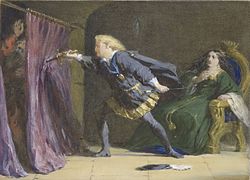
Hamlet spares Claudius while he is
praying, fearing spiritual consequences. Later, Hamlet kills Polonius by
mistake.
Literary significance:
Thought without action leads to chaos; action without thought leads to tragedy.
Act
IV: Madness, Grief, and Revenge
Ophelia goes mad after her father’s
death and later drowns. Laertes returns seeking revenge. Claudius manipulates
him into plotting Hamlet’s death.
Literary significance:
Innocent people suffer most in corrupt systems.
Act
V: Acceptance and Tragic Resolution
In the graveyard scene, Hamlet
reflects on death while holding Yorick’s skull. He realizes death is universal.
During the duel, poison kills Gertrude, Laertes, Claudius, and Hamlet.
Hamlet finally takes revenge but
dies, having accepted fate.
Literary significance:
Wisdom comes from accepting mortality.

Detailed Character Analysis
Hamlet
Hamlet is intellectual, emotional,
and philosophical. He suffers from depression and moral conflict. His tragic
flaw is indecision caused by overthinking. He represents the modern thinking
individual.
King
Claudius
Claudius is a politically skilled
villain. He is efficient and charming but morally corrupt. His guilt humanizes
him, making him complex.
Queen
Gertrude
Gertrude is loving but emotionally
weak. She seeks comfort rather than truth, allowing corruption to grow.
Ophelia
Ophelia symbolizes innocence destroyed
by power and patriarchy. Her madness is real and tragic.

Polonius
and Laertes
Polonius represents false wisdom.
Laertes represents impulsive action. Both contrast Hamlet.
Themes in Hamlet by William Shakespeare – Detailed Literary
Discussion
Themes are the backbone of Hamlet by William Shakespeare. Shakespeare does not present a
single message; instead, he layers multiple themes that interact with each
other. These themes make the play intellectually rich and emotionally powerful.
Below is an in-depth discussion of the
major and minor themes, explained clearly with literary insight.
1. Revenge
– A Central but Problematic Theme
Revenge is the driving force of Hamlet by William Shakespeare, yet Shakespeare
treats it with complexity rather than glorification. Unlike traditional revenge
tragedies, where the hero acts quickly, Hamlet delays. This delay forces
readers to question whether revenge is morally right.
Hamlet is commanded by the ghost to avenge his
father’s murder, but he struggles with the ethical and religious consequences
of killing Claudius. He fears committing a sin and possibly condemning his
soul. This hesitation transforms revenge into a moral dilemma, not a heroic duty.
Shakespeare contrasts Hamlet with Laertes and
Fortinbras:
·
Laertes
seeks immediate revenge for Polonius’s death.
·
Fortinbras
is willing to fight over honor.
·
Hamlet
reflects deeply before acting.
Through this contrast, Shakespeare shows that both delayed and impulsive revenge lead to
destruction. By the end of the play, nearly everyone involved in
revenge dies, suggesting that revenge brings suffering rather than justice.
2.
Madness – Real vs Pretended
Madness is one of the most fascinating themes
in Hamlet by William Shakespeare.
Shakespeare presents madness in two forms: pretended madness and real madness.
Hamlet pretends to be mad to hide his true
intentions. His madness allows him to:
·
Speak truth without punishment
·
Criticize corruption
·
Observe others without suspicion
Ophelia’s madness, however, is genuine. She
loses her sanity after the death of her father and Hamlet’s rejection. Her
madness is emotional and uncontrollable, shown through broken songs and
symbolic speech.
The contrast between Hamlet and Ophelia
highlights Shakespeare’s message:
·
Pretended
madness can be a tool of survival
·
Real
madness is the tragic result of emotional oppression
This theme also raises an important question: Who is truly sane in a corrupt world?
3.
Appearance vs Reality – Nothing Is What It Seems
The theme of appearance vs reality runs
throughout Hamlet by William Shakespeare.
Almost every character hides behind a mask.
Examples include:
·
Claudius appears to be a caring king but is a
murderer
·
Hamlet appears mad but is intellectually sharp
·
Rosencrantz and Guildenstern appear loyal but
betray Hamlet
·
Gertrude appears innocent but ignores moral
truth
Shakespeare suggests that truth is difficult
to identify in a world full of deception. Hamlet’s struggle is not just about
revenge but about discovering the truth
in a dishonest society.
This theme makes the play psychologically
intense, as readers are constantly questioning motives and appearances.
4.
Corruption and Moral Decay
Corruption is both a political and moral theme
in Hamlet by William Shakespeare. The
murder of King Hamlet is not just a personal crime—it poisons the entire state
of Denmark.
The famous line, “Something is rotten in the state of Denmark,” captures this
theme perfectly. Corruption spreads like disease:
·
Claudius’s crime leads to spying, betrayal, and
lies
·
Innocent characters like Ophelia suffer
·
Trust disappears from relationships
Shakespeare uses imagery of rot, poison,
disease, and decay to emphasize how one immoral act can destroy an entire
society. Denmark becomes a reflection of Claudius’s corrupted soul.
5.
Death and Mortality
Death is constantly present in Hamlet by William Shakespeare. From the
ghost’s appearance to the graveyard scene, Shakespeare forces readers to
confront the reality of death.
Hamlet’s reflections on death are
philosophical rather than fearful. He questions:
·
What happens after death?
·
Is death a release from suffering?
·
Are all humans equal in death?
The graveyard scene, especially Hamlet holding
Yorick’s skull, emphasizes that death
makes everyone equal—kings, jesters, and beggars alike.
This theme adds existential depth to the play
and makes Hamlet a deeply modern character.
6.
Action vs Inaction
One of the most debated themes in Hamlet by William Shakespeare is action
versus inaction. Hamlet constantly criticizes himself for not acting, yet his
delay is not laziness—it is thoughtful restraint.
Shakespeare shows that:
·
Thought without action leads to frustration
·
Action without thought leads to tragedy
Hamlet finally acts only after accepting fate.
This suggests that true action requires
inner clarity, not emotional impulse.
7.
Loyalty and Betrayal
Loyalty is rare in Hamlet. Most characters betray someone:
·
Claudius betrays his brother
·
Gertrude betrays her husband’s memory
·
Rosencrantz and Guildenstern betray friendship
Only Horatio remains loyal to Hamlet until the
end. Through this contrast, Shakespeare highlights the value of genuine loyalty
in a corrupt world.
8.
Gender and Power
Women in Hamlet
by William Shakespeare have limited agency. Gertrude and Ophelia are
controlled by male authority. Ophelia’s tragedy reflects the emotional damage
caused by patriarchal oppression.
This theme adds a social dimension to the
play, showing how power structures silence vulnerable voices.
Summary
Table of Themes
Theme | Key Characters | Central Idea |
Revenge | Hamlet, Laertes | Moral conflict |
Madness | Hamlet, Ophelia | Truth vs collapse |
Appearance vs Reality | Claudius, Hamlet | Deception |
Corruption | Claudius | Moral decay |
Death | Hamlet | Human equality |
Action vs Inaction | Hamlet | Moral responsibility |
Literary Devices Used in Hamlet
Device | Purpose |
Soliloquy | Reveals inner thoughts |
Symbolism | Adds philosophical meaning |
Dramatic Irony | Engages the audience |
Imagery | Reinforces themes |
Critical Analysis and Perspectives
- Psychological:
Hamlet’s delay reflects inner conflict - Existential:
Life is uncertain and painful - Political:
Abuse of power destroys society
Importance of Hamlet in English Literature
Hamlet by William Shakespeare revolutionized drama by introducing psychological realism.
It influenced writers, philosophers, and playwrights worldwide.
Modern Relevance of Hamlet
Mental health, moral confusion,
political corruption, and identity crises make Hamlet relevant even
today.
Tables for Quick Reference
Theme | Characters |
Revenge | Hamlet, Laertes |
Madness | Hamlet, Ophelia |
Corruption | Claudius |
Conclusion
Hamlet by William Shakespeare is not merely a play—it is a deep exploration of human
thought and emotion. Through Hamlet’s struggle, Shakespeare shows that being
human means questioning, suffering, and searching for truth. That is why Hamlet
remains one of the greatest works in world literature.
Frequently Asked Questions (FAQs)
1. What is the most
important theme in Hamlet by William Shakespeare?
Revenge is the central theme, but it is deeply
connected with moral conflict, madness, and corruption.
2. Why does Hamlet delay
taking revenge?
Hamlet delays because of moral, religious, and
psychological reasons. He wants certainty and justice, not blind violence.
3. Is Hamlet truly mad or
pretending?
Hamlet mostly pretends madness, while Ophelia
experiences real madness caused by emotional trauma.
4. What does the ghost
symbolize in Hamlet?
The ghost represents the unresolved past,
moral duty, and the demand for justice.
5. What message does
Shakespeare give through Hamlet?
Shakespeare suggests that unchecked corruption
destroys individuals and society, and that moral awareness is both a strength
and a burden.
6. Why is Hamlet still
relevant today?
The play deals with mental health, ethical
dilemmas, political corruption, and identity—issues still relevant in modern
society.

“Welcome to EngLiteratureGuru. I am a dedicated and experienced University Lecturer, done my MS in English Literature with distinction, a literary scholar with a mission to simplify the world’s greatest English classics for students and enthusiasts. From the intricate verses of Modern Poetry to the dramatic depth of Shakespearean tragedies like Hamlet, I provide expert analysis, historical context, and exam-ready insights. My goal is to help you bridge the gap between reading a text and truly mastering its meaning.”