Sailing to Byzantium: Summary, Text, and Explanation
W. B. Yeats’s Sailing to
Byzantium is one of those poems that grows deeper the more you read it. On
the surface, it appears to be about an old man leaving one place and sailing
toward another. But once you slow down and read carefully, the poem reveals
itself as a powerful meditation on aging, the soul, art, and the desire for
permanence.yeats uses symbolic language and compressed ideas, but when
explained patiently, the poem becomes surprisingly clear and emotionally
relatable.
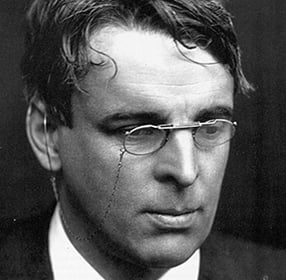
About the Poet: W. B. Yeats
William Butler Yeats (1865–1939) was
one of the greatest poets of the twentieth century and a central figure in
modern poetry. He was an Irish poet, dramatist, and Nobel Prize winner (1923).
Yeats’s early poetry was romantic and mystical, but his later work became more
philosophical, symbolic, and modern.
Yeats was deeply concerned with:
- Aging and mortality
- The relationship between body and soul
- Art as a form of immortality
- History, myth, and spirituality
Sailing to Byzantium, published in 1928 in the collection The Tower,
belongs to Yeats’s later phase, when he was reflecting on old age and
the meaning of life. The poem reflects both personal anxiety and universal
human concerns.
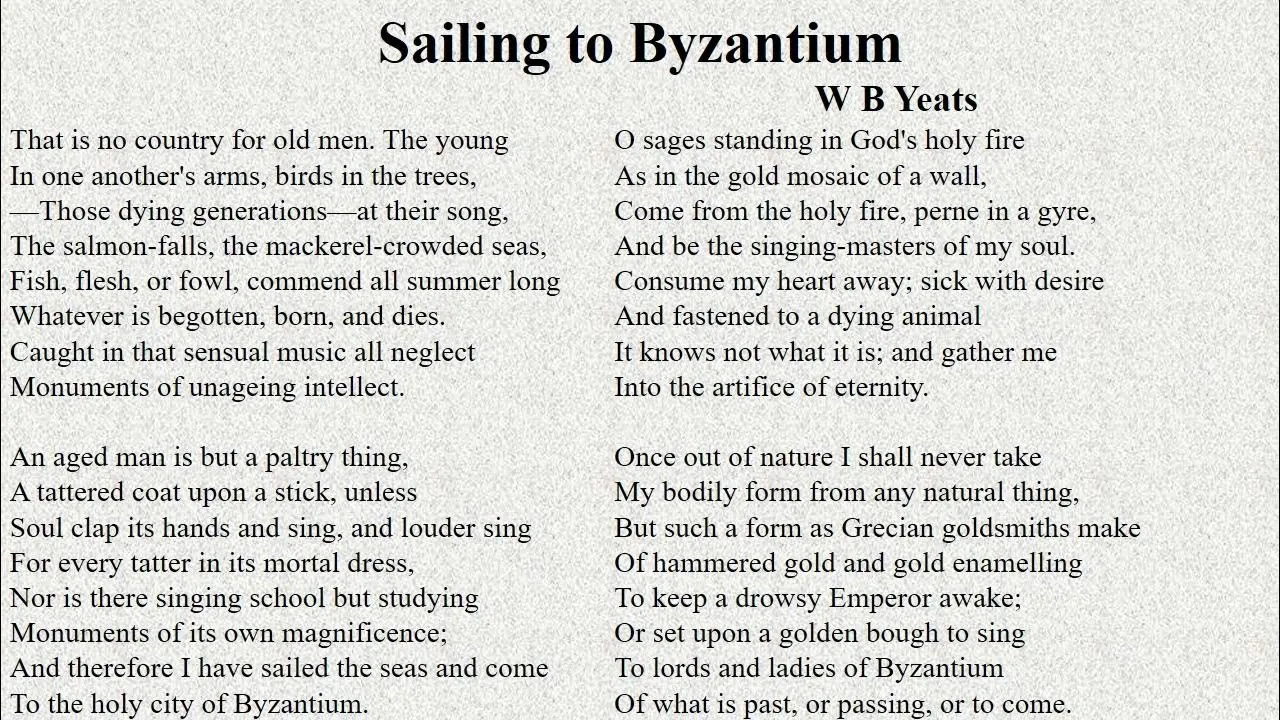
Full Text of the Poem: Sailing
to Byzantium
That is no country for old men. The young
In one another’s arms, birds in the trees,
—Those dying generations—at their song,
The salmon-falls, the mackerel-crowded seas,
Fish, flesh, or fowl, commend all summer long
Whatever is begotten, born, and dies.
Caught in that sensual music all neglect
Monuments of unageing intellect.
An aged man is but a paltry thing,
A tattered coat upon a stick, unless
Soul clap its hands and sing, and louder sing
For every tatter in its mortal dress,
Nor is there singing school but studying
Monuments of its own magnificence;
And therefore I have sailed the seas and come
To the holy city of Byzantium.
O sages standing in God’s holy fire
As in the gold mosaic of a wall,
Come from the holy fire, perne in a gyre,
And be the singing-masters of my soul.
Consume my heart away; sick with desire
And fastened to a dying animal
It knows not what it is; and gather me
Into the artifice of eternity.
Once out of nature I shall never take
My bodily form from any natural thing,
But such a form as Grecian goldsmiths make
Of hammered gold and gold enamelling
To keep a drowsy Emperor awake;
Or set upon a golden bough to sing
To lords and ladies of Byzantium
Of what is past, or passing, or to come.
Background of Sailing to Byzantium
To understand sailing to
byzantium summary and text and explanation, it is essential to know the
background of the poem. Yeats wrote this poem when he was over sixty, a time
when he felt physically weak but intellectually and spiritually active.
Byzantium (modern-day Istanbul)
symbolizes:
- A world of eternal art
- Spiritual perfection
- A civilization where art and religion were united
Yeats contrasts Byzantium with the
natural world, which he sees as dominated by youth, reproduction, and physical
pleasure. For Yeats, the physical world is temporary, while art offers
permanence.
Summary of the Poem
Sailing to
Byzantium presents the thoughts of an old man who feels completely out of
place in the physical world around him. He looks at the world of youth, nature,
and sensual pleasure and realizes that it no longer belongs to him. Everything
in this world is part of a continuous cycle of birth, enjoyment, and death.
While this cycle is natural and beautiful for the young, it leaves no
meaningful place for the elderly, whose bodies are weakening and whose desires
are changing.
The speaker feels that old age reduces the
human body to something almost useless unless the soul finds a way to assert
itself. For him, the soul can only truly live through art, learning, and
spiritual understanding. This realization motivates his symbolic journey away
from the physical world and toward Byzantium, a city that represents eternal
art and spiritual perfection.
In Byzantium, the speaker seeks guidance from
wise figures preserved in religious art. He asks them to purify his soul and
free him from the emotional and physical desires that tie him to his decaying
body. Ultimately, he imagines achieving immortality by becoming a work of art
himself—not a living creature bound by nature, but an artificial golden bird
that can sing forever. Through this transformation, the speaker believes he can
escape death and exist beyond time.
Central Idea of the Poem
The central idea of Sailing to
Byzantium is the journey from the physical world to the spiritual world.
The speaker rejects a land dominated by youth and sensuality and seeks a realm
where the soul can exist beyond time.
The poem explores:
- Old age as a form of exile
- Art as eternal
- The desire for spiritual rebirth
This idea makes the poem deeply
philosophical and symbolic, which is why it is often discussed in modern poetry
studies.
Stanza-wise Explanation
The poem opens with a bold and
memorable declaration: “That is no country for old men.” Right from the
first line, the speaker establishes a sharp divide between himself and the
world around him. The country he refers to is the natural, physical world—a
place filled with young lovers, singing birds, and abundant sea life.
Everything here is alive, energetic, and fertile. Yeats carefully lists images
of reproduction and vitality: young people embracing, birds singing in trees,
fish filling the seas. This world celebrates life in its most physical form.
However, Yeats immediately undercuts
this beauty by reminding us that all these living things belong to “dying
generations.” Even in their vitality, they are moving toward death. The key
problem, according to the speaker, is that people absorbed in this sensual
music fail to pay attention to “monuments of unageing intellect.” In other
words, they focus on physical pleasure and ignore art, wisdom, and spiritual
achievements, which alone can last beyond time.
As the poem moves forward, the
speaker turns inward and reflects on old age. He describes an aged man as “a
tattered coat upon a stick,” a brutally honest image suggesting physical decay
and emptiness. The human body, once strong and admired, becomes fragile and
almost ridiculous with age. Yet Yeats does not completely surrender to despair.
He insists that the soul can still “clap its hands and sing.” The soul, unlike
the body, can grow richer and stronger if it dedicates itself to learning and
artistic appreciation.
The speaker argues that there is no
school for the soul except the study of great works of art and intellect. This
realization explains his decision to “sail the seas” and arrive at Byzantium.
The journey is not literal; it is spiritual and imaginative. Byzantium
symbolizes a place where art, religion, and eternity exist together, untouched
by decay.
In the third stanza, the speaker
directly addresses the sages of Byzantium, figures imagined as part of golden
religious mosaics. These sages exist in “God’s holy fire,” suggesting
purification, spiritual wisdom, and eternal truth. The speaker begs them to
guide his soul and teach him how to escape the limitations of the physical
body. He asks them to burn away his heart, which is still attached to physical
desires and emotions. The heart is described as “sick with desire” and tied to
a “dying animal,” meaning the human body.
Here, Yeats expresses a deep
frustration with human instincts and emotional attachments. The speaker feels
that these desires prevent spiritual growth. He wants to be gathered into “the
artifice of eternity,” a striking phrase that suggests something artificial yet
everlasting—art that defies nature.
In the final stanza, the speaker
imagines what this eternal existence might look like. Once he escapes nature,
he does not want to take on another natural form. Instead, he wants to become a
crafted object, specifically a golden bird made by skilled Greek goldsmiths.
This bird is artificial, beautiful, and immortal. Unlike real birds, it does
not age, weaken, or die.
The golden bird’s purpose is to sing
to emperors and nobles, not of fleeting pleasures, but of time itself—past,
present, and future. Through this image, Yeats presents art as something that
transcends time and preserves human experience forever. The speaker’s desire is
not merely to survive death, but to become part of something permanent and
meaningful.
Why Sailing to Byzantium Is a Modern Poem
Although Yeats uses traditional
stanza forms, the poem is modern in thought. It deals with:
- Personal anxiety
- Existential questions
- Psychological conflict
Like modernist poets, Yeats
questions traditional beliefs and searches for meaning in art.
Conclusion
Sailing to Byzantium is a deeply philosophical poem that explores the human
desire to escape aging and achieve immortality through art. Yeats transforms
personal fear into universal meaning, making the poem timeless.
For literature lovers ,
understanding sailing to byzantium summary and text and explanation
provides insight into Yeats’s modern vision, symbolism, and belief in art as a
spiritual refuge. The poem remains relevant because it addresses questions that
every human being eventually faces—time, decay, and the hope for permanence.
Frequently Asked Questions (FAQs)
1. What is Sailing to Byzantium about in simple words?
Sailing to Byzantium is about an old man who feels out of place in a world
dominated by youth and physical pleasure. He wants to leave the natural world,
where everything ages and dies, and reach Byzantium, a symbolic place
representing eternal art and spiritual life.
2. Why does Yeats say “That is no country for old men”?
Yeats says this because the physical
world celebrates youth, love, and reproduction. Old people, whose bodies are
weak and closer to death, do not fit into this world. This line shows the
speaker’s sense of exclusion and begins his search for a higher, lasting
existence.
3. What does Byzantium symbolize in the poem?
Byzantium symbolizes a world of eternal
art, wisdom, and spirituality. It represents a place where the soul can
escape physical decay and live forever through artistic and spiritual
perfection.
4. What is meant by “a tattered coat upon a stick”?
This phrase describes the physical
condition of old age. The human body becomes weak, fragile, and almost useless,
like a worn-out coat hanging on a stick. It highlights the contrast between the
decaying body and the potentially powerful soul.
5. Why does the speaker want to become a golden bird?
The golden bird represents immortal
art. Unlike natural creatures, it does not age or die. By imagining himself
as a golden bird, the speaker wishes to escape nature and achieve permanence
through art.
6. Is the journey to Byzantium a real journey?
No, the journey is symbolic. It
represents a spiritual and imaginative movement away from the physical world
toward a timeless artistic and spiritual state.
7. What does “monuments of unageing intellect” mean?
This phrase refers to great works of
art, philosophy, and culture that do not age like the human body. Yeats
suggests that such intellectual and artistic achievements are more valuable
than physical pleasure.
8. Why does the speaker ask the sages to “consume my heart away”?
The speaker wants to be freed from
emotional and physical desires that tie him to the mortal body. By asking the
sages to consume his heart, he seeks spiritual purification and release from
bodily attachment.
9. Why is Sailing to Byzantium important for literature exams?
The poem is important for exams
because it combines personal experience with deep philosophical ideas. It
offers rich symbolism, memorable imagery, and clear progression of thought,
making it ideal for detailed textual analysis.
10. What is the central message of Sailing to Byzantium?
The central message is that while
the human body ages and dies, the soul can achieve permanence through art and
spiritual understanding. Yeats presents art as a way to transcend time and
mortality.

“Welcome to EngLiteratureGuru. I am a dedicated and experienced University Lecturer, done my MS in English Literature with distinction, a literary scholar with a mission to simplify the world’s greatest English classics for students and enthusiasts. From the intricate verses of Modern Poetry to the dramatic depth of Shakespearean tragedies like Hamlet, I provide expert analysis, historical context, and exam-ready insights. My goal is to help you bridge the gap between reading a text and truly mastering its meaning.”